Tax-Loss Harvesting in 2026: Year-End Strategy and the Case for Direct Indexing
Dominik Yates · · 9 min read

With year-end roughly ten weeks away, a meaningful tax-reduction opportunity sits in many taxable portfolios right now — and most investors aren't looking at it systematically. Tax-loss harvesting, when approached with discipline rather than as a December scramble, can reduce the taxes owed on realized gains, trim exposure to the 3.8% Net Investment Income Tax (NIIT), and generate loss carryforwards that deliver value in future years. For investors willing to go further, direct indexing turns that same principle into a continuous, year-round engine — and the data on what it produced in recent years is worth understanding.
The Mechanics: What Tax-Loss Harvesting Actually Does
Tax-loss harvesting is the practice of selling a security at a loss to offset realized capital gains and reduce taxable income, while maintaining market exposure. The IRS taxes only net gains, so harvested losses cancel gains dollar for dollar before any tax is owed. The offset order matters: short-term losses first reduce short-term gains (taxed at ordinary income rates), then long-term gains (taxed at 0%, 15%, or 20% for most investors). If losses exceed gains entirely, up to $3,000 of the excess can be applied against ordinary income annually, and any remaining unused losses carry forward indefinitely to future tax years — they don't expire.
For high-earning clients already subject to the 3.8% NIIT, harvesting losses can also help reduce or eliminate that additional layer of tax. At combined federal and state rates applicable to top-bracket investors in California, every dollar of harvested loss can save 30 cents or more in taxes — a meaningful after-tax return enhancement on its own.
The Wash-Sale Rule: The Constraint That Shapes the Strategy
The central limitation in tax-loss harvesting is the wash-sale rule. It disallows a loss if you purchase a "substantially identical" security within 30 days before or after the sale — a 61-day window total. If the rule is triggered, the disallowed loss is added to the cost basis of the replacement security, deferring the benefit rather than eliminating it permanently. That said, a deferred loss and a disallowed one are not the same thing — the basis adjustment means the tax benefit eventually surfaces, just later.
Waiting until December to harvest losses can mean missing opportunities that appeared earlier in the year.
In practice, investors avoid the wash-sale rule by replacing the sold security with a similar-but-not-identical one: selling a broad S&P 500 ETF and buying a total market ETF, for instance, or swapping a sector fund for one tracking a related but distinct index. Staying invested during the 31-day window matters, because proceeds left in cash expose the investor to missing a market rebound. One additional complexity worth coordinating: the wash-sale rule can also apply to purchases made by a spouse, or to purchases of the same security made inside an IRA — the loss is permanently disallowed in that IRA scenario, with no basis carryforward, making it the most costly version of the mistake.
Year-End Timing — and Why the Calendar Isn't the Only Window
December 31 is the hard deadline for losses to count in the current tax year. But waiting for November or December to review the portfolio carries real costs. Losses that were visible in September can disappear after a year-end rally. Executing trades late in the year also comes with liquidity pinches, potential execution delays, and the distraction of mutual fund capital-gain distributions, which often come in December — buying a fund just before its distribution date results in a taxable gain on top of a harvest.
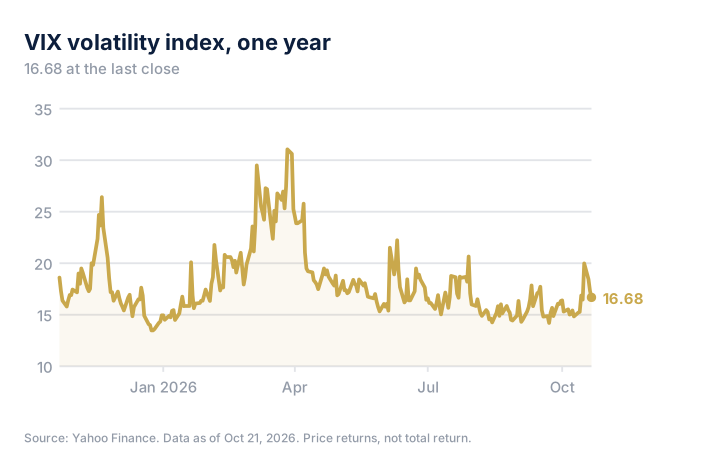
Market volatility creates the loss-harvesting windows that advisors monitor throughout the year, not just at year-end.
Research shows that 86% of financial advisors ramp up tax management strategies during volatile periods, rather than waiting for year-end. That pattern exists for a reason: losses available in a down week in March or September may no longer be available in December. A more structured approach involves reviewing the portfolio quarterly — identifying emerging loss candidates before they recover — rather than compressing the entire exercise into a few weeks at year's end.
That said, for investors who haven't done a mid-year review, now is not too late. With market conditions in 2026 reflecting mixed economic signals and sector-level divergence, taxable portfolios are likely to contain positions with embedded losses worth examining before December 31.
Direct Indexing: Turning Tax-Loss Harvesting Into a Continuous Process
For clients with sufficient taxable-account assets, direct indexing extends tax-loss harvesting from an annual exercise into a year-round system. Rather than holding a single ETF that tracks an index, a direct indexing portfolio holds the individual stocks that make up that index. When any one of those positions declines, it can be sold and replaced with a similar security — capturing a tax loss while keeping the portfolio's overall exposure intact — even if the index itself is up on the year.
Direct indexing assets hit $864.3 billion at year-end 2024, up nearly 87% from 2021. The strategy has moved from institutional-only territory to something accessible to a broader range of investors, with minimum investments ranging from $100,000 to $250,000 depending on the platform. A 2026 FTSE Russell survey found that 83% of advisors are using or plan to use direct indexing in the next 12 months, and 42% cite tax efficiency and tax-loss harvesting as the primary reason for increasing their use.
The tax alpha generated by this approach — the additional after-tax return attributable to systematic loss harvesting — is measurable. Research published in 2026 found that systematic tax-management techniques, including tax-loss harvesting, gain deferral, and tax-aware rebalancing, produce implied annualized tax alpha typically in the range of 0.7% to 3.5% for equity direct indexing. Vanguard estimates that a $1,000,000 cash investment in the S&P 500 would yield $385,000 in cumulative losses between 2015 and 2024 through a direct indexing strategy, with annual tax alpha of approximately 0.85% in federal capital gains tax savings — rising to 1.2% for investors in a high-tax state like California when state tax savings are included.
In 2025, portfolios using direct indexing generated significantly more harvesting activity than ETF-only approaches. ETF-only tax-loss-harvesting portfolios harvested $4,808 in losses on average, while portfolios that included direct indexing harvested $18,281 — generating 3.8x more harvestable losses. At a 37% tax rate, this translates to approximately $6,764 in tax offsets per household.
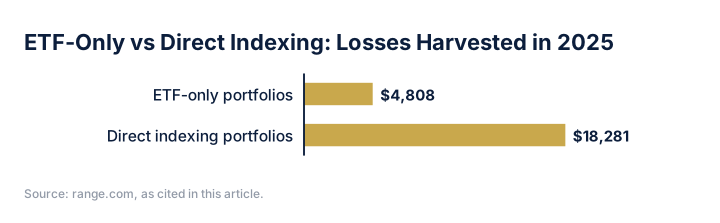
Direct indexing portfolios generated far more harvestable losses than ETF-only approaches in 2025, illustrating the strategy's year-round advantage.
Direct indexing also benefits investors managing concentrated stock positions, because losses elsewhere in the portfolio can be harvested to offset gains as a concentrated holding is gradually reduced. For a business owner anticipating a sale, or an executive with a large stock award vesting, that coordination can be a meaningful part of the overall plan.
Where Professional Management Adds Precision
Managing tax-loss harvesting manually — across multiple accounts, with wash-sale monitoring, lot-level accounting, and coordination with a spouse's holdings — is operationally complex. Missing a wash-sale violation because of a purchase inside an IRA costs the investor the entire loss, permanently. Failing to coordinate harvest timing with an expected liquidity event (a property sale, a Roth conversion, a business exit) means the losses may not be available when the gains arrive. These aren't theoretical risks; they're the kinds of errors that appear most frequently in portfolios that were harvested reactively rather than by design.
Direct indexing holds individual stocks rather than a single fund, allowing losses on any one position to be harvested independently.
Daily monitoring — the kind available through systematic direct indexing platforms — captures opportunities that a quarterly or annual review misses. It also allows for specific lot identification when selling, which gives the investor control over which shares are sold (highest-cost lots first, typically), rather than defaulting to FIFO (first in, first out), which often produces a smaller loss or an unintended gain. That choice, made at each transaction, compounds over time.
Tax-loss harvesting is most valuable when it's systematic — built into the portfolio's ongoing management rather than executed under deadline pressure in December.
Common questions
What is the $3,000 ordinary income deduction for capital losses, and how does it work?
When capital losses exceed capital gains in a given year, the IRS allows taxpayers to deduct up to $3,000 of the excess against ordinary income ($1,500 if married filing separately). For someone in the top federal bracket, that deduction could meaningfully reduce their tax bill in a single year. Any losses above that $3,000 limit carry forward indefinitely to future tax years, where they offset future gains first and then ordinary income again, in the same order.
How is direct indexing different from owning an index ETF?
An index ETF holds a basket of securities inside a single fund — you own shares of the fund, not the underlying stocks. With direct indexing, you own the individual stocks that make up the index directly in your own account. That structure makes it possible to harvest losses on individual positions even when the index as a whole is up for the year, because individual stocks within any index move differently. The tradeoff is higher minimum investment requirements — typically $100,000 to $250,000 — and greater operational complexity compared to holding a single ETF.
Is tax-loss harvesting appropriate for IRA or 401(k) accounts?
No — and this is a common source of confusion. Inside a traditional IRA or 401(k), all growth is tax-deferred, and withdrawals are taxed as ordinary income regardless of how they were generated. In a Roth account, growth is tax-free. Neither structure benefits from loss harvesting, because there are no capital gains to offset inside the account. Tax-loss harvesting and direct indexing belong in taxable brokerage accounts, where the tax consequences of each transaction are real and immediate. Placing a harvested position into an IRA within the wash-sale window also permanently disallows the loss with no basis adjustment, which is an especially costly error.
Sources
Harvesting losses may help reduce or eliminate exposure to the 3.8% net investment income tax (NIIT)
IRS: $3,000 ordinary-income deduction; excess losses carry forward indefinitely
Raymond James: direct indexing minimums typically $100,000 to $250,000
IRS Schedule D instructions: $3,000 capital loss deduction limit ($1,500 MFS)